Site Map | Contact | Cart | Log in  
   
RSS Feed Twitter Newsletter
productsServicesCertificationAbout UsWhat's NewSurveys 101

Surveys 101 > Hogan Alumni News

Hogan Assessment Systems periodically publishes a newsletter exclusively for their Hogan certified alumni. They have allowed us to share some of this valuable information with our customers.  We will update this periodically so check back frequently . . .

FAQ: Do the Hogan Assessment Tools measure elements of Emotional Intelligence?
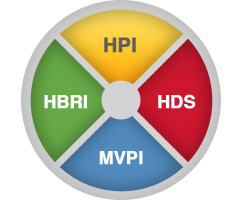
Hogan often receives inquiries regarding the degree to which the HPI and HDS and measures of emotional intelligence (a) tap into the same constructs (i.e., predict similar outcomes) and (b) can be used for similar purposes.

Well-constructed measures of emotional intelligence measure competencies that can (and should) be learned in order to succeed on the job (competencies are behaviors that are inherently changeable). In contrast, the HPI and HDS predict stable characteristics, the constancy of which is confirmed by strong test-retest reliability coefficients. For example, individuals cannot learn to be more prudent as Prudence is a stable characteristic. However, via feedback and facilitation of self-insight, they can learn how others perceive them, and, as a result, change the behaviors that cause others to perceive them in a more or less prudent manner.

In summary, just as the Hogan assessment tools can be used to predict performance in terms of an organization’s competencies, the Hogan assessment tools also can be used to predict performance in terms of emotional intelligence (also specified in terms of competencies) because the constructs assessed via the HPI and HDS underlie behaviors described as more or less emotionally intelligent.


Did You Know?  The Hogan assessment tools are available in over 40 different languages. Adapting an assessment instrument to a different culture and language is challenging, and must be handled with accuracy and deep cultural understanding.
Here’s how Hogan approaches the language/culture issue and testing:
Initial Forward Translation – A fully fluent and bi-cultural translator with psychological training and background will translate the test items into the target language. They need to understand both cultures so they can comprehend the meaning in the U.S. culture and adapt as appropriate for the target culture. They need to be psychologists so they have an understanding of item construction and do not take translation liberties that harm the psychometric properties of the assessment item.

1)  Translation Review – A speaker of the target language reviews the item for 4 criteria: grammar/syntax, same content as the original item, cultural relevance and accuracy, and same strength of wording (e.g., “I love public speaking” vs. “I don’t mind public speaking”).
2)  Pilot-testing – The assessment is administered to 4-6 people to see if they have any difficulties. If there are any problems with the items, they tend to emerge during pilot-testing.
3)  Implementation – The assessment runs live on our system and may be used for administration. During this period, Hogan monitors item statistics and assessment results to look for any anomalous or unusual patterns.
4)  A simple forward, then back translation may miss the meaning altogether behind the item theme. For example, let’s look at this HDS item, “I take pride in being a good follower.” When translated into standard Turkish, the word “follower” was interpreted as stalking, like a private investigator, rather than following directions from others.

Therefore, it’s vital when using adaptation that the translation content yields meaning that is the same in both cultures, even if the words differ. This requires a fully fluent translator who understands both the original culture and the target culture.


Interesting
Information . . .


Click here to see an overview of our products and services!

Click 
here to contact us!


PRODUCTS | SERVICES | TRAINING | ABOUT | PPI BLOG | SURVEYS 101
PO Box 630, Old Saybrook, CT 06475    1-800-565-4223 (U.S. & Canada)   •  1-860-388-9422
Contact UsSite Map • Privacy Policy
We self-certify compliance with US-EU SAFEHARBOR
©1998-2013 Performance Programs, Inc.